Aleiah's Integer Adventure :The Quest for Juice
One morning, Aleiah woke up, and wanted some juice. When she opened the fridge, she discovered that they were out of juice!
"Oh no! Now I will have to go out and buy some!" cried Aleiah.
So she put on her purple sweater and got her Hello Kitty coin pures and set out. On her way, she came across a box in the middle of the sidewalk.
"I wonder whats inside..."she said,"I will open it."
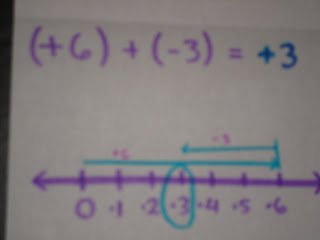
Inside she saw this question:

"Wow this is weird," she thought," but since I opened it, I might as well solve it.
Aleiah used the number line to solve this question.

"That was easy" she thought,"I am such a genius!"
Aleiah continued walking until a man in blue scuba gear stood in her way. She couldn't walk around him because the road was being fixed, and he took up the whole sidewalk.
"If you answer my question, I will move." said the man.
"Sigh, okay"she said," but only because I love juice."
This was the man's question:

"I can solve this!" Aleiah exclaimed. This is how she solved it:
"Very good..." said the man, and with that, he sucked in his enormous stomach and let her through. Yes, it was all very weird...
"Wow, this is a very unusual day..." thought Aleiah,"Cool!"
As you probably guessed, another weird thing happened. She probably would have been at the store by now, but noooo. Everyone just had to keep asking her math questions. This time, it was a girl.
"My calculator broke." she said,"If you answer this question, I will give you a coupon for a free can of juice."
"Okay! Sure! Bring on the question." said Aleiah. Free juice!
"This is my question..."

"Oh! I know how I can solve this!" she said. Here is how she did it:

"Thank you very much for your help, here is the coupon."she said.
"YAY! Thanks! Free juice!" yelled Aleiah. This was turning out to be a good day.
Suddenly, a huge box fell from the sky!
"Wow, that was really random."thought Aleiah,"I wonder if something is trying to tell me something..."
The box was locked, but there was (you guessed it) an integer question on the side.
Here is the question:
.JPG)
"Hmm, I think I know how I can solve this..."
This is how she did it:
tiles.JPG)
As soon as she had solved the question, the box became unlocked. Now normally, Aleiah wouldn't have looked in the box and would have just gone on her way to the store. Today however, wasn't a normal day. So she looked in the box. Whoosh! She was transported to another world! Yes, this story is very random.
Where has she been transported to? Will she ever return? Will she ever get to use her free coupon!? Find out next week!
Part 2
It is now next week. Where were we... Oh yes!
The world she was transported to was...CANDY WORLD! (how was your Halloween?) Yes CANDY WORLD. The sky was pink, there were rainbows and lollipops. Cotton candy trees as far as the eye could see. There was even a chocolate river! It didn't look as good as it tasted though.
"This looks a lot like the Candy Land board game..."said Aleiah.
"Greetings tall one!" said a short man called.
"Who are you?" asked Aleiah,"You kind of remind me of the little people from the Wizard of Oz movie."
"They were based on us! We are the ORIGINAL Lollipop-kin!" said the short guy.
"Do you have any juice?" she asked,"I'm really thirsty."
"Sorry, but we only drink chocolate beverages" he said," we only need to sleep for 3 hours!"
"Now I kmow why you're vibrating" she said," How can I get out of this juice-less world?"
"Just follow the yellow brick road till you get to the Wunka (I meant to spell it this way) factory. Then the great scientist of Oz will help you."
" Thanks. Say, mind if I take a peice of this house for the road?" she asked, already breaking off part of the chocolate door.
" Who hasn't already?" he said with a sigh. "I'm off to Home Depot"
On her way, she met a scarecrow driving a tin car. The scarecrow said the would give her a ride if she could answer their question:
(+15) - (+17)
"Hm... I got it!" she exclaimed. Here's her solution.
(+15) + (-17) = -2
"Wow! You're smart. " said the tin car.
"Get in." said the scarecrow with a smile.
The trio drove until they reached the Wunka factory. It was HUGE! And smelled like mint chocolate! Hmm...
Once inside, she told the Scientist of Oz her problem.
"All you need to do is tap your shoes together... and solve this integer question."he said.
"There's the catch" she mumbled under her breath.
This was the question:
8 - (-7) + 3 - (-5)
"Well, this is different. But I can do this!". Here's how Aleiah solved it.
8 + 7 + 3 + 5 = 23
"Now tap your shoes." he reminded her.
"Theres no place like home-"
"Theres no need for that." he said, stifling a laugh.
As soon as she tapped her shoes together, she found herself in front of the store. Was it all a dream? Then she felt the melting chocolate in her pocket. No, it was definetly not a dream.
She was finally able to buy her juice. Thanks to the coupon, she bought her favourite Fruitopia strawberry-kiwi juice. Yay! But just when you think things are back to normal, the cashier called after her.
"We need you for a top secret mission. Are you in?" said the lady who was suddenly dressed in black. Everyone wants a peice of the genius.
"Will there be juice?" Aleiah asked.
"Sure" said the lady.
" Ok then. I've got nothing to do."
What will happen next? Will she get a cool black suit? See next time on "Tales of Integers!"
Thanks for commenting!
 245% of 365.80 is 874.16
 68 3/4% of 730 is 501.875
 360% of 129.95 is 467.82


 Remember that


 I used division to solve this problem.


 Square:


.bmp)
(-3).bmp)
(-3)%3D6.bmp)
(-3).bmp)
(2)(-3).bmp)
(-3)%3D6+%232.bmp) You can also do it this way:
You can also do it this way:(-3)%3D6%232.bmp)

